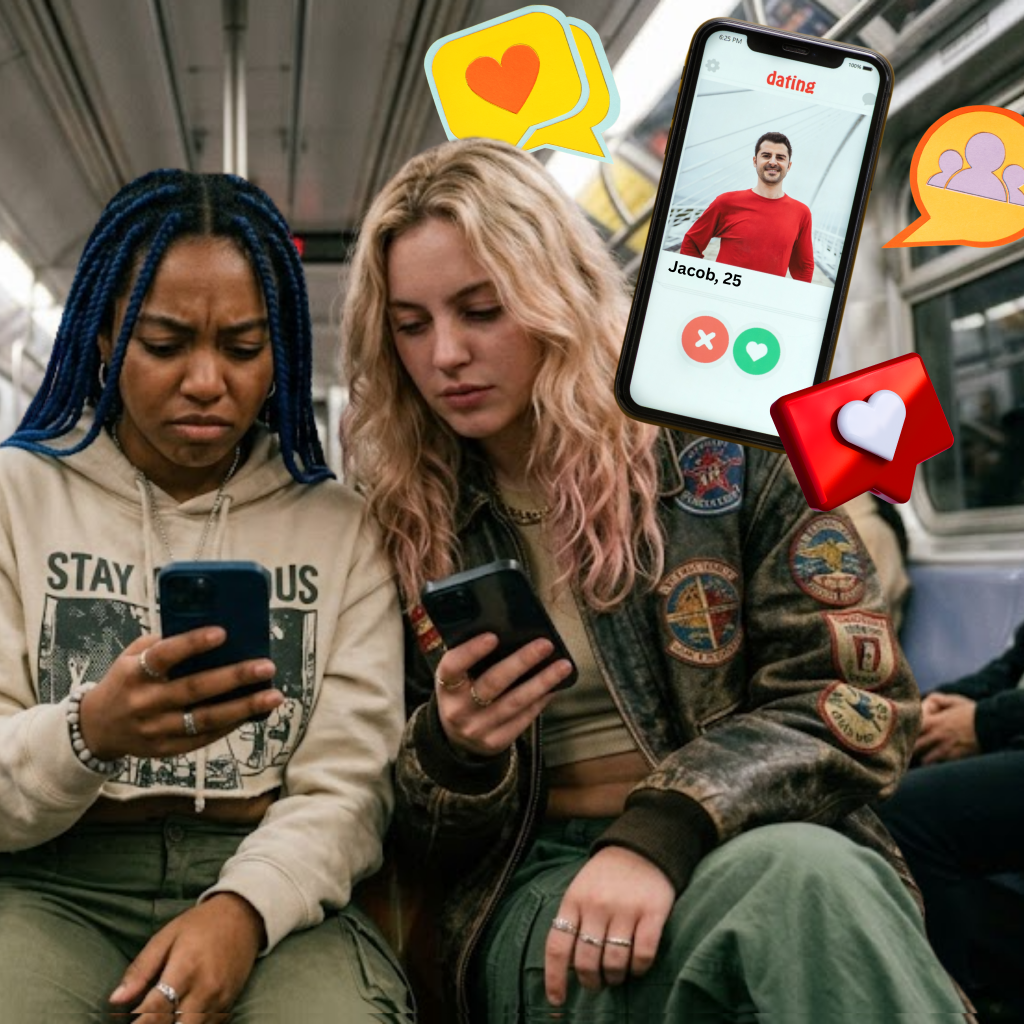
A new campus trend called “SABSing” (See And Be Seen) has students closing their laptops, sitting on the lawn, and lingering in cafés — deliberately making themselves visible so they can meet people in person again.
Even Tinder agrees the apps aren’t delivering connection. Its global CMO says too much time online gave Gen Z “social atrophy,” and the company is now spending one of its biggest investments in a decade to get users off the app and into in-person events.
The takeaway for the Church: young adults are starved for real, unpressured, face-to-face community — exactly what a healthy local church has always been. The only question is whether your church is ready to be that place.
Two stories captured our attention this month, from two very different corners of the culture. Read together, they point straight back to the local church.
The first, from Vice, introduces a campus trend called “SABSing.” The second, from Marketing Brew, reveals that Tinder — the company that helped move dating onto our phones in the first place — is now racing to move it back off.
What is “SABSing,” and why are students doing it?
SABSing stands for “See And Be Seen.” Coined in 2024 by a University of Pennsylvania student editor, it’s the practice of making yourself visible and approachable in public — sitting out on the quad, reading at the café, lingering long enough to catch the eye of a crush and strike up a conversation the old-fashioned way. One therapist quoted in the piece describes it as a return to the basics, before algorithms, when people simply met “in the wild.”
Students say the appeal is the freedom of it: no scheduling, no swiping, no pressure. Just showing up where other people are and letting connection happen.
Why are young people quitting dating apps?
Because, as Vice bluntly puts it, the apps have become exhausting — and young people are craving actual connection. What’s striking is that the users aren’t the only ones saying it. The platforms are, too.
Even Tinder is admitting the apps failed at connection
According to Marketing Brew, Tinder is expanding “Tinder Events” — cooking classes, trivia, mahjong nights, run-club-style gatherings — to 26 cities across the U.S. and Europe. The feature grew out of work with anthropologists and social psychologists who confirmed that being too online produced a kind of “social atrophy”: Gen Z simply hasn’t built the in-person muscle that earlier generations took for granted. Tinder’s stated goal for the whole initiative is to get you to put your phone down and make a real connection.
Sit with that for a moment. When a dating app pours one of its largest investments in a decade into getting people offlineand into a room together, it’s telling us something important about the moment we’re in.
Isn’t this exactly what the Church has always been?
Here’s the connection we can’t unsee. Strip away the trend names and the app features, and what you have is an entire generation desperate for a place to be seen, known, and met — consistently, week after week, without an algorithm in the middle. That’s not a product any startup invented. It’s the oldest community-building institution in the country.
The local church is the original “See and Be Seen.” A weekly, multigenerational gathering where people show up in person, friendships form, relationships begin, and belonging is the point. Everything Tinder is spending millions to manufacture, the Church already has in its DNA.
But belonging doesn’t happen automatically. Many churches have quietly stepped back from this role, especially for single young adults — who often find no clear on-ramp into real relationships once the closing song ends. The hunger is there. The infrastructure to meet it frequently isn’t.
What can the Church learn from this moment?
This is where Communio comes alongside you. We help churches turn Sunday attendance into genuine relational community — the kind that builds real friendships, prepares young adults for healthy dating and marriage, and keeps people connected for the long haul. We bring the data, the model, and the tools that make it work; you bring the people and the place.
The cultural moment is doing the hard part of your outreach for you. Gen Z is already looking up from their phones and asking, out loud, “Where can I find real connection?” The Church is meant to be that answer. Our job is to help you be ready when they walk in.
Ready to make your church that place?
Young adults are done with the swipe. They’re looking for somewhere to belong. Let’s make sure that when they go looking, your church is the place they find.
Partner with Communio → and let’s build the relational ministry your community is already searching for.
New to Communio? Start with our free Pastor’s Guide to see how healthy relationships become the front door to a thriving church.